
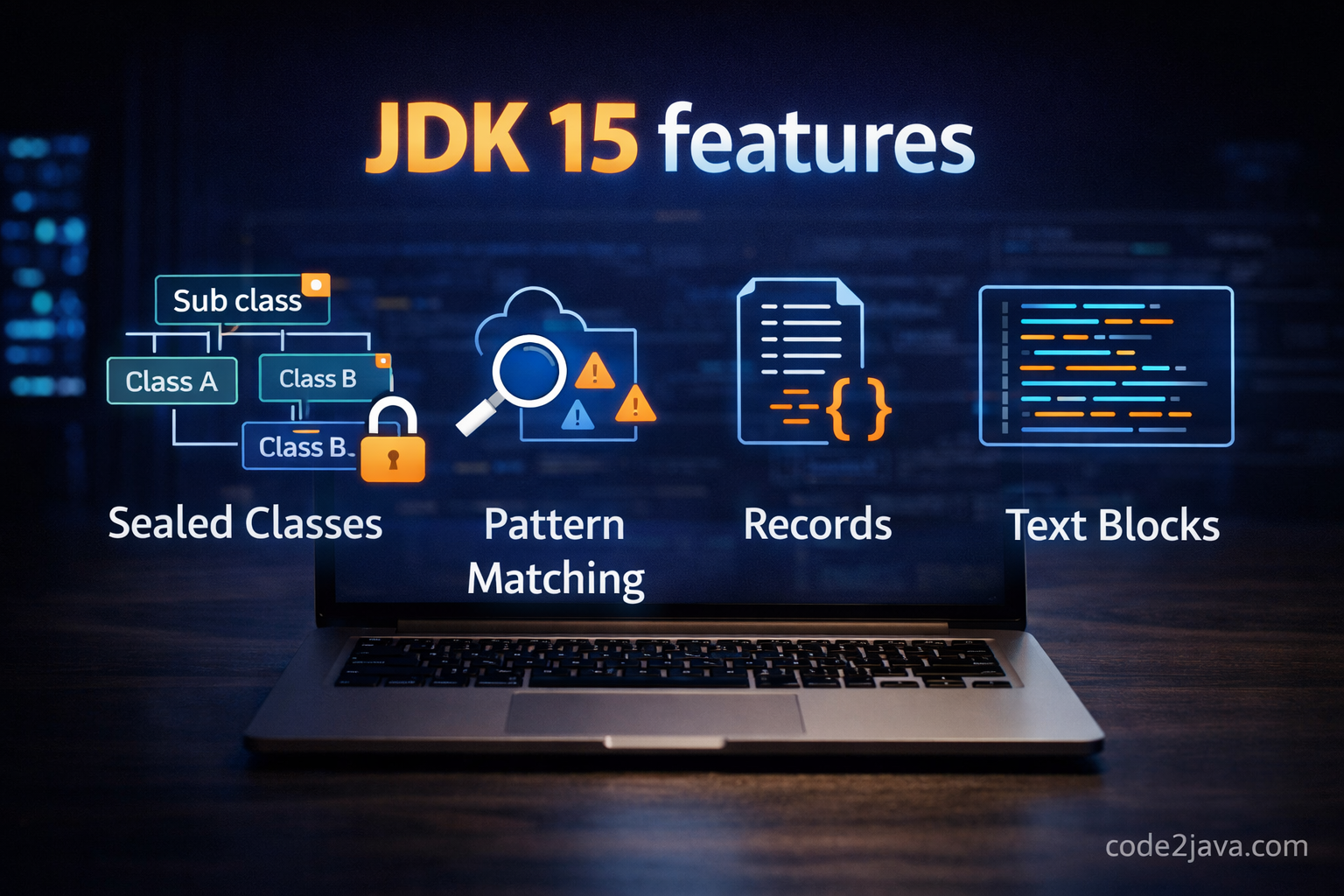
JDK 15 features
Table of Contents
- 👉 What is JDK 15
- 👉 Why JDK 15 is important
- 👉 Key features introduced in JDK 15
- 👉 Internal working of major features
- 👉 Implementation in Java
- 👉 Summary
- 👉 Interview Questions
👉 What is JDK 15
JDK 15 is a non-LTS (Short-Term Release) version of Java, but don’t underestimate it. It introduced several important features that later became stable in JDK 17.
Think of JDK 15 as an innovation release — where new ideas were introduced, tested, and refined.
👉 Many features like Text Blocks and Sealed Classes started gaining real traction here.
👉 Why JDK 15 is important
Even though it’s not LTS, JDK 15 plays a critical role in Java evolution.
🔥 Why it matters:
- ✔ Introduces preview features (future of Java)
- ✔ Improves developer productivity
- ✔ Enhances JVM internals
- ✔ Reduces boilerplate code
- ✔ Prepares foundation for JDK 17
👉 If you understand JDK 15, you understand the direction Java is heading.
👉 Key JDK 15 Features
Let’s break down the most important features in a practical way.
🔥 1. Text Blocks (Standard Feature)
Writing multi-line strings was always messy in Java.
JDK 15 finally fixes that.
⚙ Internal Working Insight
- Uses triple quotes “””
- Preserves formatting
- Removes unnecessary escape characters
- Compiler normalizes indentation
👉 Cleaner code, especially for JSON, SQL, XML.
💻 Implementation in Java
public class TextBlockExample {
    public static void main(String[] args) {
        String json = """
                {
                    "name": "Java",
                    "version": 15
                }
                """;

        System.out.println(json);
    }
}
👉 No more \n and ” everywhere.
🔥 2. Sealed Classes (Preview)
Sealed classes restrict which classes can extend them.
⚙ Internal Working Insight
- Uses
permitskeyword - JVM verifies allowed subclasses
- Helps in domain modeling
👉 Makes inheritance controlled and predictable.
💻 Implementation in Java
sealed class Shape permits Circle, Rectangle {
}

final class Circle extends Shape {
}

final class Rectangle extends Shape {
}
👉 Prevents unwanted extensions.
🔥 3. Hidden Classes
This is a JVM-level feature, mainly useful for frameworks.
⚙ Internal Working Insight
- Classes are not discoverable via reflection
- Used internally by frameworks like proxies
- Short-lived and dynamically generated
👉 Improves performance and security for dynamic class generation.
💻 Example Concept
// No direct usage like normal classes
// Used internally via MethodHandles.Lookup
👉 You won’t use it directly, but frameworks do.
🔥 4. ZGC Improvements
Z Garbage Collector continues to evolve.
⚙ Internal Working Insight
- Reduced latency
- Improved memory handling
- Better scalability
👉 Designed for large-scale, low-latency systems.
🔥 5. Shenandoah Garbage Collector (Production Ready)
Another low-pause GC option.
⚙ Internal Working Insight
- Performs concurrent compaction
- Reduces pause times significantly
- Ideal for real-time applications
👉 Now production-ready in JDK 15.
🔥 6. Records (Second Preview)
Records were refined further in JDK 15.
⚙ Internal Working Insight
- Immutable data carriers
- Compiler auto-generates boilerplate code
👉 Simplifies DTO creation.
💻 Implementation in Java
record User(String name, int age) {
}

public class RecordExample {
    public static void main(String[] args) {
        User user = new User("Alice", 25);
        System.out.println(user.name());
    }
}
👉 No getters/setters needed.
🔥 7. Pattern Matching for instanceof (Second Preview)
Further refinement of pattern matching.
⚙ Internal Working Insight
- Combines type check and casting
- Reduces runtime errors
💻 Implementation in Java
public class PatternMatchingExample {
    public static void main(String[] args) {
        Object obj = "Java";

        if (obj instanceof String str) {
            System.out.println(str.length());
        }
    }
}
👉 Cleaner and safer code.
🔥 8. EdDSA Cryptographic Algorithm
New cryptographic signature algorithm added.
⚙ Internal Working Insight
- Faster and more secure than traditional algorithms
- Uses Edwards-curve Digital Signature Algorithm
👉 Important for security-focused applications.
🔥 9. Foreign-Memory Access API (Incubator)
Allows Java to access memory outside JVM heap.
⚙ Internal Working Insight
- Works without JNI
- Safer and more efficient
- Uses MemorySegment abstraction
👉 Useful for high-performance applications.
💻 Conceptual Example
// Simplified concept (API was incubator)
👉 This is the future of native memory access in Java.
👉 Implementation in Java
Let’s combine multiple JDK 15 features in one example 👇
sealed interface Vehicle permits Car, Bike {
}

record Car(String name, int speed) implements Vehicle {
}

record Bike(String name, int speed) implements Vehicle {
}

public class JDK15Demo {

    public static void printDetails(Vehicle vehicle) {
        if (vehicle instanceof Car c) {
            System.out.println("Car: " + c.name() + ", Speed: " + c.speed());
        } else if (vehicle instanceof Bike b) {
            System.out.println("Bike: " + b.name() + ", Speed: " + b.speed());
        }
    }

    public static void main(String[] args) {

        String text = """
                Welcome to JDK 15
                Features Demo
                """;

        System.out.println(text);

        Vehicle v1 = new Car("Tesla", 200);
        Vehicle v2 = new Bike("Yamaha", 120);

        printDetails(v1);
        printDetails(v2);
    }
}
👉 Notice how modern and clean Java starts to feel.
👉 Summary
JDK 15 is a feature-rich release that pushed Java toward modernization.
🔥 Key takeaways:
- Text Blocks simplify multi-line strings
- Sealed Classes introduce controlled inheritance
- Records reduce boilerplate
- Pattern Matching improves readability
- JVM improvements enhance performance
👉 JDK 15 laid the groundwork for JDK 17.
If you want to understand deeper Java internals, check this:
https://code2java.com/internal-implementation-of-hashmap/
👉 Interview Questions
👉 1. What are the major features introduced in JDK 15?
👉 2. What are Text Blocks and why are they useful?
👉 3. Explain Sealed Classes with examples.
👉 4. What are Hidden Classes in JVM?
👉 5. How do Records reduce boilerplate code?
👉 6. What is Pattern Matching for instanceof?
👉 7. What improvements were made in garbage collectors?
👉 8. What is the Foreign-Memory Access API?