Part 14: API Gateway — Why Every Distributed System Eventually Needs One
As organizations move from monolithic applications to microservices, they usually focus on breaking functionality into independent services. Teams separate orders, payments, inventory, notifications, user management, and dozens of other capabilities into independently deployable components. Initially, this architectural transformation feels like progress because services become smaller, teams gain autonomy, and deployments become significantly more flexible.
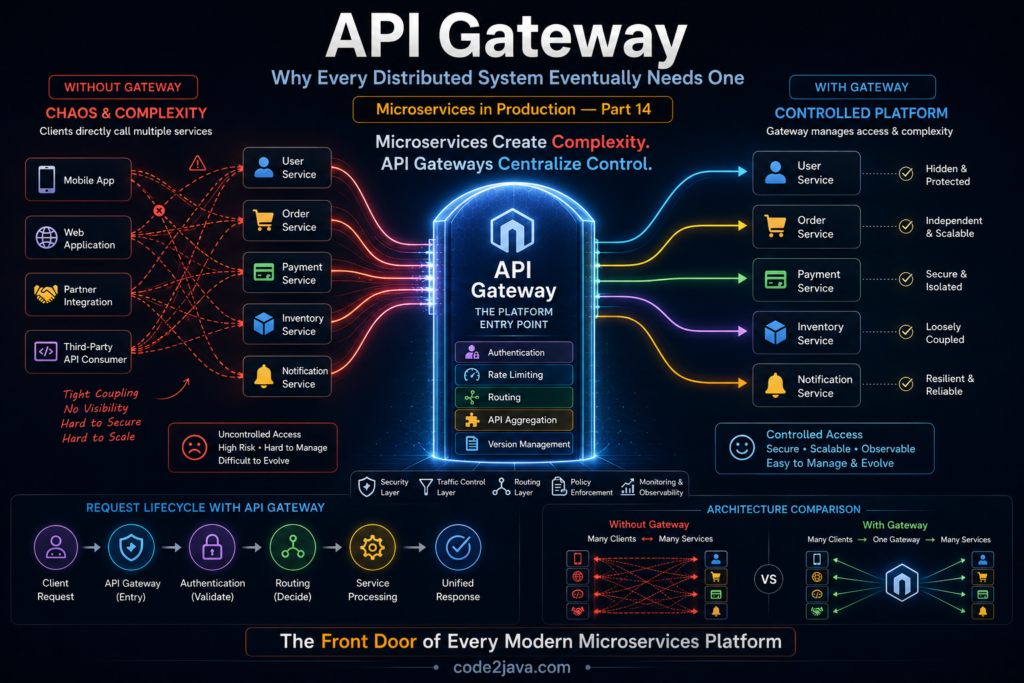
However, another challenge begins to emerge as the number of services grows. The problem is no longer how services communicate with each other. The problem becomes how clients communicate with the platform.
Customers still expect a simple experience. Mobile applications, web portals, partner integrations, and external consumers do not care how many services exist behind the scenes. They simply want reliable access to business functionality.
Without proper control, the architecture starts exposing its internal complexity directly to consumers. This is the point where most organizations realize that distributed systems need a controlled entry point. That entry point eventually becomes the API Gateway.
1. Why Microservices Create Entry Point Chaos
One of the hidden benefits of a monolithic application is simplicity from the consumer’s perspective.
Regardless of how many modules exist internally, clients typically interact with a single application endpoint. Authentication, routing, business logic, and database access all remain hidden behind one unified interface.
Microservices change this model completely.
As functionality becomes distributed, organizations often expose multiple services independently. User management may have its own endpoint. Order processing may expose a separate API. Payment services may operate independently. Inventory and shipping services may introduce additional endpoints.
Initially, this seems manageable.
As the platform grows, however, clients become tightly coupled to internal architecture decisions. Every new service potentially introduces new endpoints, new authentication requirements, new routing rules, and new integration patterns.
The client suddenly needs to understand how the backend is organized.
This creates a long-term architectural problem because internal service boundaries should remain an implementation detail. Consumers should not need to know whether a business capability is implemented by one service or twenty.
Without abstraction, microservices can unintentionally expose complexity rather than reduce it.
Organizations quickly discover that they need a way to hide internal architecture while still allowing services to evolve independently.
2. The API Gateway Becomes the Front Door of the Platform
The API Gateway emerged as a solution to this growing complexity.
At a high level, the gateway acts as the single entry point for external traffic entering the platform. Clients communicate with the gateway rather than communicating directly with individual services.
While this sounds simple, the architectural impact is significant.
The gateway creates a clear separation between consumers and internal implementation details. Mobile applications no longer need to know where the Order Service runs. Partner integrations do not need to understand how payment processing is implemented. External consumers simply interact with a stable interface while the platform evolves behind the scenes.
This separation creates flexibility. Teams can restructure services, migrate infrastructure, introduce new versions, or split services further without forcing consumers to change how they interact with the system.
From an architectural perspective, the gateway becomes more than a routing component. It becomes the front door of the platform. Everything entering the system passes through a controlled boundary before reaching internal services.
As distributed systems mature, this boundary becomes increasingly important.
3. Why Authentication Naturally Moves to the Gateway
One of the first operational challenges organizations encounter in microservices is authentication.
Without a gateway, every service often implements its own authentication logic. Services validate JWT tokens, process OAuth flows, enforce access rules, and perform identity checks independently.
Initially, this appears reasonable. Over time, it creates duplication across the platform.
Every service must maintain authentication libraries. Security updates require modifications across multiple teams. Policy enforcement becomes inconsistent because each service may interpret requirements slightly differently.
The operational overhead grows continuously, Organizations eventually recognize that authentication is not business logic, it is platform logic.
The API Gateway provides a natural location for handling these responsibilities.
Instead of forcing every service to validate incoming requests independently, the gateway can authenticate requests before they enter the platform. Services then receive verified identity information and can focus on business responsibilities rather than authentication mechanics.
This approach simplifies service design while improving consistency. More importantly, it creates a centralized security boundary that is easier to manage and audit.
As security requirements become more sophisticated, gateways often evolve into one of the most important enforcement points in the architecture.
4. Request Routing Is More Complex Than Most Teams Expect
At first glance, routing appears straightforward. A request arrives and gets forwarded to the appropriate service.
In production environments, routing becomes significantly more sophisticated.
Organizations often need to route requests based on URLs, domains, customer segments, geographic regions, API versions, or deployment strategies.
A request for:
/ordersmay need to reach the Order Service.
A request for:
/paymentsmay need to reach a completely different backend.
The complexity increases further when organizations introduce canary releases, blue-green deployments, or versioned APIs. The gateway must now determine not only where traffic should go, but also which version of a service should receive the request.
What initially looked like a simple forwarding mechanism gradually evolves into a sophisticated traffic management layer. This capability allows organizations to evolve services independently without forcing clients to understand infrastructure changes occurring behind the scenes.
5. Rate Limiting Protects Services from Their Own Success
One of the most underestimated responsibilities of an API Gateway is traffic protection. Distributed systems rarely fail because of a lack of functionality, they often fail because demand exceeds capacity.
Traffic spikes, aggressive clients, integration errors, and automated bots can generate enormous volumes of requests in very short periods of time. Without protection mechanisms, these requests can overwhelm downstream services and create cascading failures throughout the platform.
Rate limiting provides a controlled response to this problem. Instead of allowing unlimited traffic to flow through the architecture, the gateway enforces predefined limits that protect backend systems from excessive demand.
This protection becomes especially valuable during unexpected events. A marketing campaign may generate sudden traffic growth. A client bug may accidentally create request storms. A partner integration may exceed expected usage patterns.
Without rate limiting, these situations often propagate pressure directly into core business services. With rate limiting, the gateway absorbs and controls the impact before it reaches critical systems.
This capability transforms the gateway from a routing layer into a stability mechanism.
6. API Aggregation Simplifies Client Interactions
As platforms grow, clients often need data from multiple services to fulfill a single user interaction.
Consider a customer opening an e-commerce dashboard.
The application may require:
- User profile information
- Recent orders
- Payment status
- Product recommendations
- Loyalty rewards
Without an aggregation layer, the client must communicate with multiple services independently. Each request introduces additional latency, network overhead, and complexity.
Mobile applications are particularly sensitive to this problem because network conditions frequently vary across devices and locations.
The API Gateway can simplify this interaction by aggregating data from multiple services and returning a unified response.
From the client’s perspective, one request produces one response. Internally, the gateway coordinates communication with multiple services.
This approach reduces network round trips, improves response times, and simplifies client development.
The architecture remains distributed, but the complexity remains hidden behind the gateway.
7. API Versioning Becomes a Long-Term Platform Challenge
One of the realities of software evolution is that APIs rarely remain unchanged. Business requirements evolve. Data structures change. New capabilities emerge. Existing consumers continue depending on older versions.
Without a strategy, API evolution quickly becomes difficult to manage. Organizations may need to support multiple API versions simultaneously while encouraging consumers to adopt newer capabilities gradually.
The API Gateway provides a centralized mechanism for managing this transition. Instead of forcing every service to implement versioning independently, the gateway can direct requests to appropriate backend implementations while maintaining a consistent interface for consumers.
This allows organizations to evolve services without creating disruption across the ecosystem.
Version management may not seem important during the early stages of a platform. At scale, it becomes one of the most critical aspects of API governance.
8. The API Gateway Can Become a Bottleneck
Every architectural decision introduces trade-offs. The API Gateway is no exception.
While the gateway simplifies routing, security, aggregation, and governance, it also introduces a new dependency into the architecture. Every request now flows through a centralized component. If the gateway becomes overloaded, poorly configured, or unavailable, large portions of the platform may become inaccessible.
This creates a paradox.
The gateway simplifies the architecture while simultaneously becoming one of its most critical components. Organizations must therefore design gateways with the same rigor applied to other mission-critical services. High availability, horizontal scaling, redundancy, monitoring, and performance optimization become essential.
The gateway solves many problems, but it must never become the largest problem in the platform. Mature organizations recognize this risk early and design accordingly.
9. API Gateway vs Service Mesh — Understanding the Difference
As organizations mature their platform engineering capabilities, they often encounter another architectural component known as the Service Mesh. Because both technologies influence traffic flow, teams frequently confuse them.
The distinction becomes clearer when viewed through communication boundaries.
- The API Gateway primarily manages traffic entering and leaving the platform. This is often referred to as north-south traffic.
- The Service Mesh focuses on communication occurring inside the platform between services. This is known as east-west traffic.
The gateway manages external interactions. The service mesh manages internal interactions. Both are important. Neither replaces the other.
In mature distributed systems, these components often work together to create consistent traffic management across both external and internal communication paths.
This distinction becomes increasingly important as platforms continue growing in scale and complexity.
10. Why API Gateways Become Strategic Platform Components
Most organizations initially adopt API Gateways to solve routing challenges.
Over time, the gateway evolves into something much larger. It becomes the centralized location for security enforcement, traffic management, API governance, rate limiting, observability, policy control, and platform standardization.
The gateway gradually shifts from infrastructure component to strategic platform capability.
This evolution reflects a broader trend in distributed systems. As architectures become more complex, organizations increasingly rely on shared platform capabilities that reduce duplication and improve consistency across services.
The API Gateway embodies this principle. It allows individual teams to focus on business functionality while the platform handles common concerns consistently.
That separation of responsibilities becomes one of the defining characteristics of mature microservices ecosystems.
Summary
Microservices provide flexibility and scalability, but they also introduce communication complexity. As the number of services grows, exposing internal architecture directly to consumers creates operational, security, and governance challenges.
The API Gateway solves these challenges by acting as the controlled entry point into the platform. It centralizes routing, authentication, rate limiting, aggregation, API versioning, and traffic management while hiding internal implementation details from consumers.
However, the gateway is not simply a routing layer. It becomes a strategic platform component that shapes how consumers interact with the architecture.
Organizations often adopt API Gateways to simplify access to services. Mature organizations leverage them to standardize security, governance, observability, and operational control across the entire platform.
In modern distributed systems, the API Gateway is not merely an infrastructure component.
It is the front door through which the platform presents itself to the world.
Interview Questions
What issues arise when an API gateway applies rate limiting per IP address in a deployment where all clients route through a corporate NAT or proxy?
Root Cause: IP-based rate limiting treats all traffic from the same IP address as a single entity. When multiple clients share a NAT IP — a common pattern in corporate networks, mobile carrier NATs, or Kubernetes pod-to-node mappings — all of their requests count against a single rate limit bucket. Internal Behaviour: A rate limit of 1000 req/min per IP applies to all clients sharing that IP combined. If 50 clients each send 30 req/min (1500 total), all 50 are rate-limited even though each individual client is well within a reasonable per-client threshold. The gateway returns 429 responses to all clients from that IP. Production Impact: Legitimate enterprise customers behind a shared egress IP are intermittently blocked while the overall request rate appears normal per client. The pattern is hard to diagnose because the affected users share no common characteristic visible in the application layer. Fix: Rate limit on authenticated identity (API key, JWT subject, tenant ID) rather than IP address. IP-based rate limiting is appropriate for unauthenticated endpoints where identity is not known, but should be layered behind identity-based limits for authenticated traffic.
How does the system behave when a client uses exponential backoff retry logic on a 429 response from the API gateway, but the gateway rate limit window resets on a fixed clock interval?
Root Cause: A fixed-window rate limiter (e.g., 1000 requests per minute, reset at :00 seconds) has a boundary vulnerability: up to 2000 requests can pass in a 1-second window around the reset — 1000 at the end of one window and 1000 at the start of the next. Client retry logic that does not respect the Retry-After header compounds this. Internal Behaviour: When a client backs off for N seconds after a 429 and the window resets at a fixed interval, the retry arrives either within the same exhausted window or at the reset boundary with other clients also retrying. This produces a coordinated burst at the reset point. Production Impact: The downstream services behind the gateway receive traffic spikes at the window reset boundary that exceed their steady-state capacity, even though the rate limiter is functioning as designed. Fix: Gateways should use sliding-window or token bucket algorithms instead of fixed windows to smooth traffic. Clients must respect the Retry-After response header value rather than computing their own backoff. Add jitter to all client retry delays regardless of the server-provided hint.