JVM as a First-Class AI Platform: Why Enterprises Are Moving AI to Java
Table of Contents
- What does JVM as an AI platform even mean
- Why companies are shifting AI to JVM
- How it actually works under the hood
- Java AI ecosystem (what you can use today)
- Summary
- Interview Questions
What does JVM as an AI platform even mean
Let’s be honest, if someone says “AI development”, most of us immediately think of Python. Right?
Same here.
But when you step into real enterprise systems, things look very different.
👉 Most production systems are already running on Java.
So instead of asking:
“Should we build AI in Python?”
Teams are now asking:
👉 “Can we run AI where our system already exists?”
That’s exactly what this shift is about.
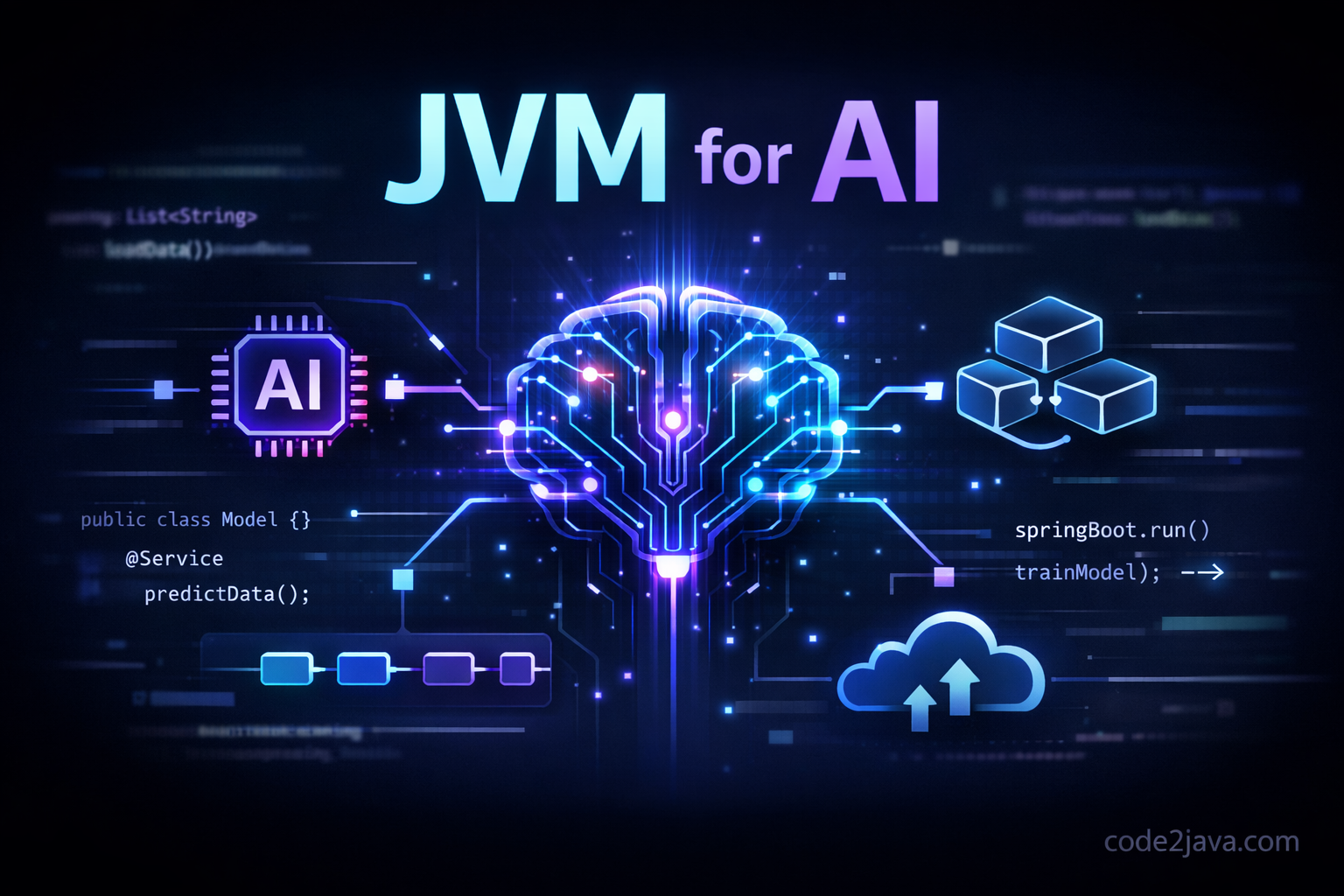
When we say JVM as a first-class AI platform, it simply means:
- AI models can run inside Java applications
- Your Spring Boot services can directly perform inference
- No need to call a separate Python service
💡 Think of it like this:
Instead of sending data to AI, you bring AI to your data.
Why companies are shifting AI to JVM
This isn’t some trend driven by hype. It’s coming from real problems teams face in production.
Less moving parts
We’ve seen setups like – Java service → Python service → result
Looks clean on diagrams, but in reality:
⚠️ Network latency becomes noticeable
⚠️ Debugging becomes painful
⚠️ Deployments double
👉 One failure and you’re digging through logs across services.
With JVM-based AI:
- Everything runs in one place
- Debugging is simpler
- Architecture becomes cleaner
Existing ecosystem
Most companies already have:
- Spring Boot services
- Kafka pipelines
- Monitoring tools
So adding AI inside JVM is just an extension, not a migration.
👉 No need to introduce a completely new stack.
Performance predictability
Java, inherently gives you:
- Stable performance
- Mature threading
- Reliable memory handling
For inference workloads, consistency matters more than raw experimentation speed.
💡 Small insight: Training is where Python shines. Inference is where Java feels more “production-ready”.
Data stays local
Moving data between services has hidden costs:
- Serialization overhead
- Network delays
- Security concerns
👉 Running AI inside JVM removes all of that.
How it actually works under the hood
This is where things get interesting.
Java is not trying to replace AI engines.
👉 It’s acting as the coordinator.
JVM and JIT optimization
When Java runs:
- Code is compiled into bytecode
- JVM identifies frequently executed paths
- JIT compiles them into optimized native code
👉 If your service keeps calling the model, performance improves over time
💡 You’ll notice this in long-running services — things just get faster after warm-up.
Native engines do the heavy lifting
Libraries like DJL connect to:
- PyTorch
- TensorFlow
- ONNX Runtime
So internally:
Java → Native engine → Result
👉 Java manages flow, native libraries handle computation
Memory management
AI workloads create lots of temporary objects:
- Tensors
- Intermediate results
JVM handles this using:
- G1 GC
- ZGC for low latency
💡 Real-world tip:
If GC tuning is ignored, you might see random latency spikes during inference.
Concurrency
Java’s concurrency model is a big advantage.
You can:
- Run parallel inference
- Handle multiple requests efficiently
- Scale without much effort
With virtual threads:
👉 High concurrency becomes much easier to manage
Java AI ecosystem
You’re not starting from zero here.
Some useful libraries:
- Deep Java Library (DJL)
- Tribuo
- Smile
- ND4J
Most teams today prefer DJL for inference use cases.
Training vs deployment
In practice, most systems follow this approach:
👉 Train in Python
👉 Export model
👉 Run in Java
💡 This hybrid model works really well in production.
Real-world architecture
A typical setup looks like this:
- Spring Boot service
- Embedded AI model
- Database or Kafka integration
Flow:
Request → Service → AI inference → Response
👉 No extra services, no unnecessary complexity
Summary
This shift is not about replacing Python, it’s about simplifying production systems.
👉 Train where it’s easy – Python
👉 Run where it’s stable – Java
JVM is becoming a strong AI platform because:
- It integrates easily into existing systems
- It reduces architectural complexity
- It handles production workloads reliably
💡 Final thought:
If you already know Java, you’re not behind in AI. You’re actually closer than you think.