
JDK 25 Features Explained with Real-World Understanding
Let’s go deeper into what actually matters.
📌 Table of Contents
- What is Java 25
- Virtual Threads (Deep Dive)
- Structured Concurrency (Deep Dive)
- Scoped Values
- Pattern Matching Enhancements
- String Templates
- Removed JVM Flags & Features
- Real-world usage
- Summary
- Interview Questions
🚀 What is Java 25
Java 25 continues the modern Java journey.
The focus is very clear:
👉 Make concurrency simple
👉 Reduce JVM complexity
👉 Remove unsafe legacy behavior
👉 Improve performance without breaking code
🧵 Virtual Threads – Deep Dive
Let’s slow down here, because this is where things get really interesting.
Virtual threads are not just “lightweight threads”. That’s an oversimplification.
They fundamentally change how Java handles concurrency.
👉 The Old Model (Platform Threads)
Before virtual threads:
👉 Each Java thread = one OS thread
👉 OS handles scheduling
👉 Thread creation is expensive
👉 Memory overhead is high (~1MB stack per thread)
So naturally, we used:
👉 Thread pools
👉 Async frameworks
👉 Reactive programming
👉 The New Model (Virtual Threads)
With virtual threads:
👉 JVM manages threads
👉 Threads are extremely lightweight
👉 Stack is stored dynamically
👉 Blocking is no longer expensive
⚙️ Internal Working
- Virtual thread mounts on a carrier thread
- Executes normally
- On blocking → JVM unmounts it
- Carrier thread is reused
- Virtual thread resumes later
⚙️ Execution Model
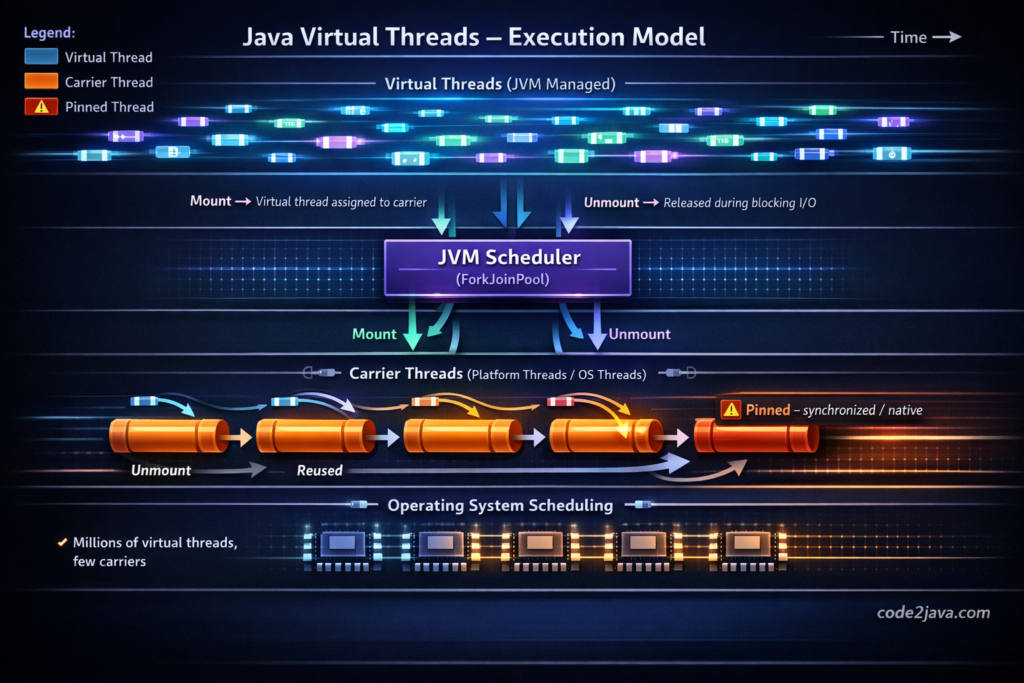
The diagram explains how Java Virtual Threads (Project Loom) enable massive concurrency by decoupling application threads from OS threads. Thousands of lightweight virtual threads are managed by the JVM and scheduled onto a small number of carrier (OS) threads via the JVM Scheduler (ForkJoinPool). When a virtual thread runs, it is mounted to a carrier thread for execution.
During blocking operations like I/O, the virtual thread is unmounted, allowing the carrier thread to be reused immediately for another task. This makes the system highly efficient, enabling millions of concurrent tasks with minimal threads. However, in cases like synchronized or native code, threads can become pinned, preventing reuse and reducing scalability.
💡 Continuation Concept
👉 Execution state is captured
👉 Thread pauses without blocking OS thread
✅ Example
public class VirtualThreadDeepExample {

    public static void main(String[] args) throws InterruptedException {

        for (int i = 0; i < 10000; i++) {
            Thread.startVirtualThread(() -> {
                try {
                    Thread.sleep(1000);
                    System.out.println(Thread.currentThread());
                } catch (InterruptedException e) {
                    e.printStackTrace();
                }
            });
        }

        Thread.sleep(3000);
    }
}
💼 Real-world Usage
👉 REST APIs
👉 Microservices
👉 DB-heavy apps
🧩 Structured Concurrency – Deep Dive
Structured concurrency makes multiple threads behave like a single unit.
Structured Concurrency is a way to manage multiple concurrent tasks as a single unit of work. Instead of handling threads independently, it groups related tasks under a shared scope, making execution more organized and predictable.
A parent task creates child tasks and waits for them to complete. If any task fails, the entire group can be cancelled automatically, preventing partial or inconsistent results.
This approach simplifies error handling, improves debugging, and avoids issues like orphan threads or resource leaks. It also aligns concurrency with the natural flow of code.
How It Works
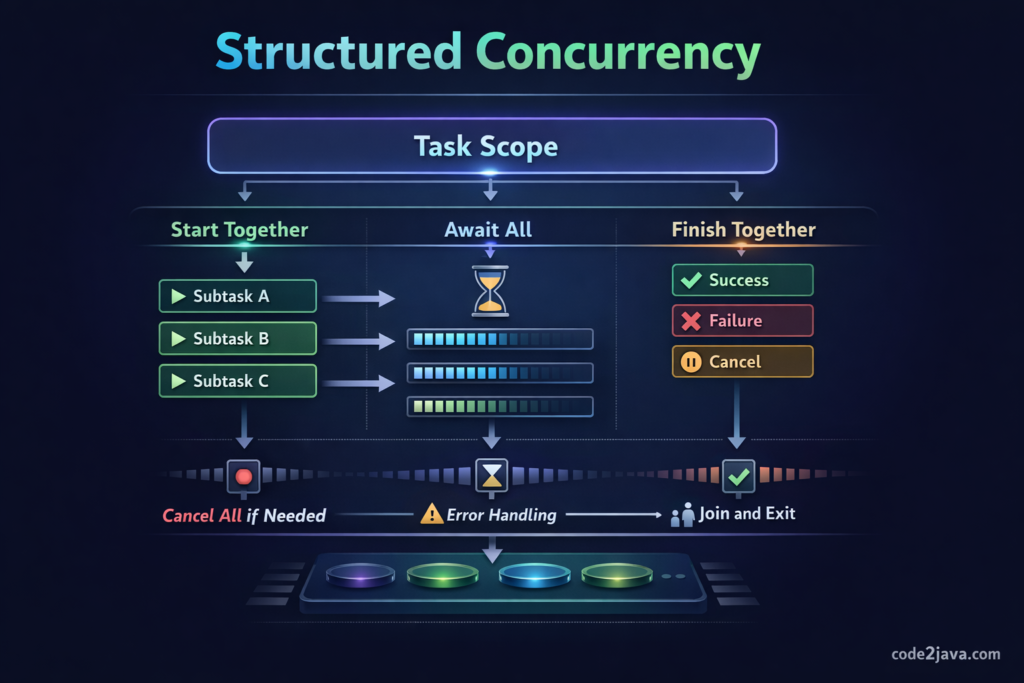
Multiple subtasks are managed within a single, well-defined scope. All tasks start together under a parent context (“Task Scope”), ensuring they are logically grouped and controlled as one unit. The system waits for all subtasks to complete (await all), maintaining a clear lifecycle from start to finish.
It also highlights built-in error handling: if one task fails, others can be cancelled to avoid inconsistent states. The flow ensures tasks either complete successfully together or fail together, followed by a clean “join and exit”. This model improves readability, reliability, and control in concurrent programming.
Why it matters
👉 Better error handling
👉 Clean lifecycle
👉 No orphan threads
📦 Scoped Values
Scoped values are a safer replacement for ThreadLocal.
Let’s see a more realistic example.
Example: Request Context Handling
import java.lang.ScopedValue;

public class ScopedValueExample {

    static final ScopedValue<String> REQUEST_ID = ScopedValue.newInstance();

    public static void main(String[] args) {

        ScopedValue.where(REQUEST_ID, "REQ-123")
                .run(() -> processRequest());
    }

    static void processRequest() {
        log("Processing started");
        serviceLayer();
    }

    static void serviceLayer() {
        log("Inside service layer");
    }

    static void log(String message) {
        System.out.println("[" + REQUEST_ID.get() + "] " + message);
    }
}
👉 What’s happening here
👉 REQUEST_ID is available across method calls
👉 No need to pass parameters manually
👉 Automatically cleaned after execution
💼 Real-world usage
👉 Logging trace IDs
👉 Security context
👉 Transaction context
🔀 Pattern Matching Enhancements
Pattern matching has become much more powerful.
Example 1: Switch Pattern Matching
public class PatternMatchingSwitch {

    public static void main(String[] args) {

        Object obj = 100;

        String result = switch (obj) {
            case String s -> "String value: " + s;
            case Integer i -> "Integer value: " + i;
            case null -> "Null value";
            default -> "Unknown";
        };

        System.out.println(result);
    }
}
Example 2: Nested Record Pattern
record Address(String city, String country) {}
record User(String name, Address address) {}

public class NestedPatternExample {

    public static void main(String[] args) {

        Object obj = new User("Rahul", new Address("Pune", "India"));

        if (obj instanceof User(String name, Address(String city, String country))) {
            System.out.println(name + " lives in " + city + ", " + country);
        }
    }
}
👉 Why this is powerful
👉 No manual casting
👉 Direct data extraction
👉 Cleaner business logic
💼 Real-world usage
👉 Parsing API responses
👉 DTO transformations
👉 Validation logic
🧾 String Templates
String templates make string building much cleaner.
Example 1: Basic Usage
String name = "Rahul";
int price = 500;

String result = STR."Product: \{name}, Price: \{price}";
System.out.println(result);
Example 2: SQL Query (Safer Approach)
String user = "admin";

String query = STR."SELECT * FROM users WHERE username = '\{user}'";
System.out.println(query);
Example 3: JSON Response
String name = "Rahul";
int age = 25;

String json = STR."""
{
    "name": "\{name}",
    "age": \{age}
}
""";

System.out.println(json);
👉 Why this matters
👉 Cleaner than concatenation
👉 Less error-prone
👉 Easier to maintain
📉 Removed JVM Flags & Features
❌ Removed GC Flags
👉 -XX:+UseConcMarkSweepGC
👉 -XX:CMSInitiatingOccupancyFraction
👉 -XX:+UseCMSInitiatingOccupancyOnly
❌ Obsolete Flags
👉 -XX:+AggressiveOpts
👉 -XX:+UseBiasedLocking
❌ Finalization
Avoid this:
@Override
protected void finalize() {}
❌ Security Manager
Being phased out due to modern alternatives.
💼 Real-world Impact
Modern backend system using Java 25:
👉 Virtual threads handle requests
👉 Structured concurrency manages workflows
👉 Scoped values handle context
Result:
👉 Cleaner code
👉 Better performance
👉 Less debugging
✅ Summary
Java 25 focuses on real-world improvements.
👉 Virtual Threads simplify scaling
👉 Structured Concurrency simplifies async
👉 Scoped Values clean context handling
👉 Pattern Matching improves readability
👉 String Templates simplify strings
👉 JVM cleanup reduces confusion
🎯 Interview Questions
- What are virtual threads and how do they work internally?
- What is continuation in Java?
- How does structured concurrency improve error handling?
- What is the difference between ThreadLocal and ScopedValue?
- How does pattern matching reduce boilerplate?
- What are string templates used for?
- Why are JVM flags removed?