JDK 26 features – Understanding the Evolution, Not Just Features
📚 Table of Contents
- What is JDK 26?
- Feature Evolution with Timeline
- Internal JVM Improvements
- Removed Features
- Practical Example
- Summary
- Interview Questions
🤔 What is JDK 26?
JDK 26 is a non-LTS release, focused on:
👉 Refinement of Project Loom features
👉 Stabilizing preview APIs
👉 JVM performance improvements
💡 Think of it as:
“Java polishing what it introduced in JDK 19–25”
🧵 Structured Concurrency
📅 Timeline
- JDK 19 → Incubator
- JDK 21 → Preview
- JDK 22–25 → Refinement
- JDK 26 → Behavioral consistency + lifecycle improvements
⚠️ Problem (Before JDK 19)
Java treated threads as independent tasks, making it hard to manage related operations together.
🔄 What Changed Over Time
Structured Concurrency introduced the idea of grouping tasks as a single unit, improving control and readability.
🚀 What Improved in JDK 26
- More predictable cancellation behavior
- Better failure propagation across tasks
💥 Impact
👉 Reduces concurrency bugs
👉 Makes parallel code easier to reason about
👉 Before (Traditional Approach)
ExecutorService executor = Executors.newFixedThreadPool(2);

Future<String> user = executor.submit(() -> fetchUser());
Future<String> order = executor.submit(() -> fetchOrder());

user.get();
order.get();👉 JDK 26 Approach
try (var scope = new StructuredTaskScope.ShutdownOnFailure()) {

    var user = scope.fork(() -> fetchUser());
    var order = scope.fork(() -> fetchOrder());

    scope.join();
    scope.throwIfFailed();

    return user.resultNow() + order.resultNow();
}🧠 Scoped Values
📅 Timeline
- JDK 20 → Incubator
- JDK 21 → Preview
- JDK 22–25 → Refinement
- JDK 26 → Better integration with Loom APIs
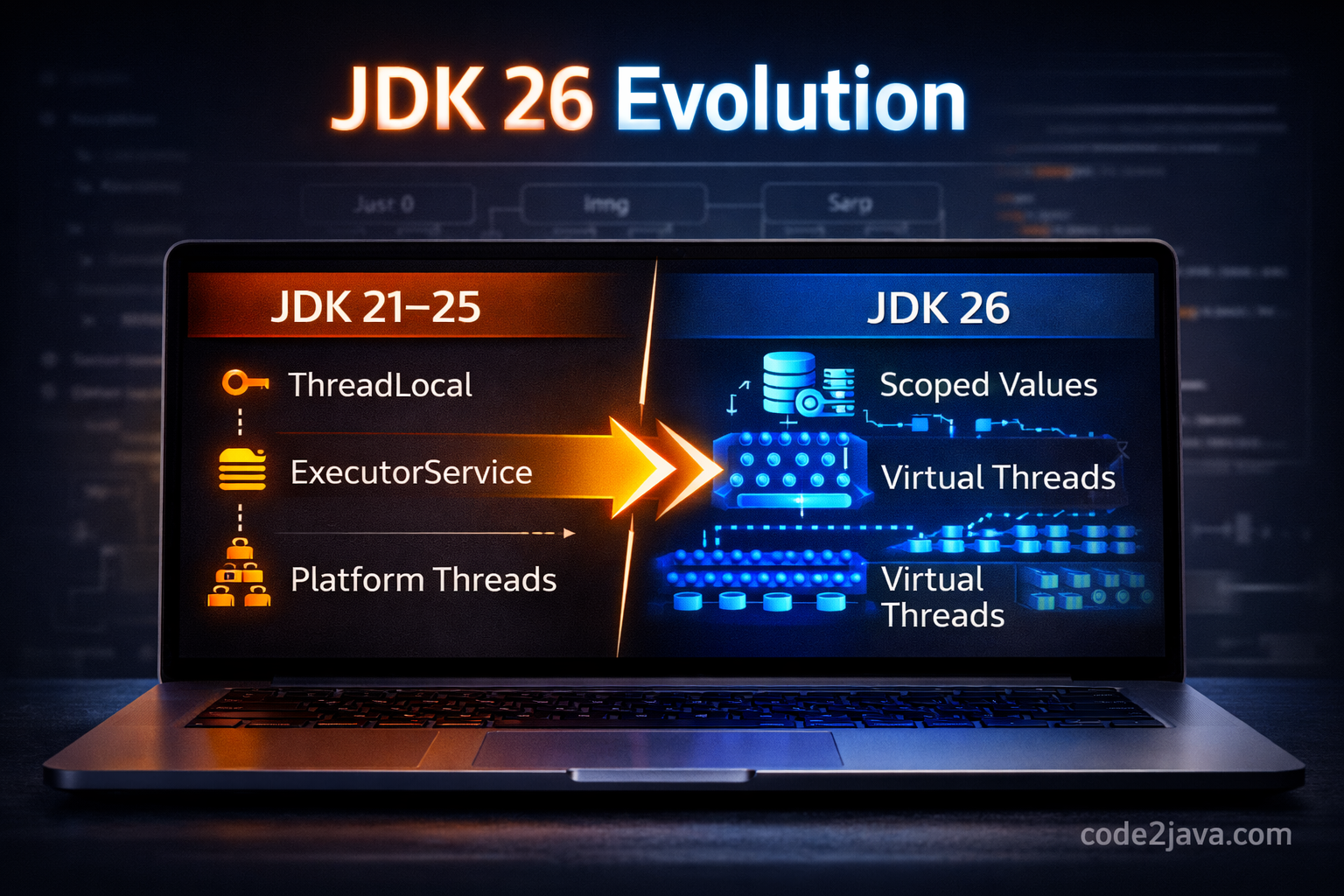
⚠️ Problem (ThreadLocal Era)
ThreadLocal caused memory leaks and unpredictable behavior, especially in async or thread-reuse scenarios.
🔄 What Changed Over Time
Scoped Values introduced immutable, context-bound data sharing across threads.
🚀 What Improved in JDK 26
- Better compatibility with structured concurrency
- Cleaner propagation across virtual threads
💥 Impact
👉 Eliminates memory leak risks
👉 Makes context passing predictable
👉 Before (ThreadLocal)
ThreadLocal<String> user = new ThreadLocal<>();
user.set("Rohit");👉 JDK 26 Style
static final ScopedValue<String> USER = ScopedValue.newInstance();

ScopedValue.where(USER, "Rohit").run(() -> {
    process();
});⚡ Virtual Threads
📅 Timeline
- JDK 19 → Preview
- JDK 21 → Stable
- JDK 22–25 → Performance tuning
- JDK 26 → Scheduler + memory improvements
⚠️ Problem (Platform Threads)
Traditional threads were heavyweight, limited by OS, and expensive to scale.
🔄 What Changed Over Time
Virtual Threads introduced lightweight threads managed by JVM, removing OS dependency.
🚀 What Improved in JDK 26
- Better scheduling fairness
- Reduced memory footprint
- Improved blocking efficiency
💥 Impact
👉 Enables massive scalability
👉 Simplifies async programming
👉 Before
ExecutorService executor = Executors.newFixedThreadPool(100);
👉 JDK 26
try (var executor = Executors.newVirtualThreadPerTaskExecutor()) {
    executor.submit(() -> process());
}🧩 Pattern Matching
📅 Timeline
- JDK 16 → instanceof pattern
- JDK 17–21 → switch patterns
- JDK 22–25 → Refinements
- JDK 26 → Minor consistency improvements
⚠️ Problem (Older Java)
Type checking required manual casting, leading to verbose and error-prone code.
🔄 What Changed Over Time
Pattern matching removed boilerplate and made type checks safer.
🚀 What Improved in JDK 26
- Improved consistency across pattern constructs
- Better readability in complex conditions
💥 Impact
👉 Cleaner and more maintainable code
👉 Before
if (obj instanceof String) {
    String s = (String) obj;
}👉 Modern Java
if (obj instanceof String s && s.length() > 5) {
    System.out.println(s);
}📦 Class-File API
📅 Timeline
- JDK 22 → Introduced (Preview)
- JDK 23–25 → Refinement
- JDK 26 → API maturity improvements
⚠️ Problem (Earlier)
Bytecode manipulation required complex third-party libraries like ASM, which were hard to maintain.
🔄 What Changed Over Time
Java introduced an official API for safer class file manipulation.
🚀 What Improved in JDK 26
- Cleaner abstraction
- More stable API surface
💥 Impact
👉 Easier framework and tooling development
⚙️ Internal JVM Improvements
🧠 Garbage Collection
⚠️ Problem
Applications experienced pause time spikes under heavy load.
🔄 Change
Continuous tuning of ZGC/Shenandoah.
🚀 JDK 26 Improvement
- Better region handling
- Reduced latency spikes
💥 Impact
👉 More stable production systems
⚡ Startup Time
⚠️ Problem
Microservices suffered from slow startup time.
🔄 Change
Class Data Sharing (CDS) improvements.
🚀 JDK 26 Improvement
- Faster class loading
💥 Impact
👉 Faster deployments and scaling
📊 JIT Compiler
⚠️ Problem
Generic optimizations didn’t always produce optimal performance.
🔄 Change
Smarter runtime optimizations.
🚀 JDK 26 Improvement
- Better inlining decisions
- Loop optimizations
💥 Impact
👉 Faster execution without code changes
❌ Removed / Deprecated Features
⚠️ Problem
Legacy APIs and weak algorithms created security and maintenance risks.
🔄 Change
Gradual removal of outdated components.
🚀 JDK 26 Cleanup
- Weak crypto removed
- Old JVM flags removed
💥 Impact
👉 More secure and maintainable applications
💻 Practical Example (Putting It All Together)
package com.code2java.jdk26.examples;

import java.util.concurrent.StructuredTaskScope;
import java.util.concurrent.Executors;

public class Jdk26ConcurrencyExample {

    // ScopedValue for request context
    static final ScopedValue<String> REQUEST_ID = ScopedValue.newInstance();

    public static void main(String[] args) {

        System.out.println("Starting JDK 26 Concurrency Demo...\n");

        // Using Virtual Threads Executor
        try (var executor = Executors.newVirtualThreadPerTaskExecutor()) {

            // Setting Scoped Value
            ScopedValue.where(REQUEST_ID, "REQ-2026")
                    .run(() -> {

                        // Using Structured Concurrency
                        try (var scope = new StructuredTaskScope.ShutdownOnFailure()) {

                            var task1 = scope.fork(() -> handleUser());
                            var task2 = scope.fork(() -> processOrder());

                            // Wait for all tasks
                            scope.join();

                            // Throw exception if any task fails
                            scope.throwIfFailed();

                            System.out.println("\nFinal Results:");
                            System.out.println(task1.resultNow());
                            System.out.println(task2.resultNow());

                        } catch (Exception e) {
                            System.err.println("Error occurred: " + e.getMessage());
                        }
                    });

        }

        System.out.println("\nExecution Completed.");
    }

    private static String handleUser() {
        simulateWork("Fetching User");
        return "User handled with Request ID: " + REQUEST_ID.get();
    }

    private static String processOrder() {
        simulateWork("Processing Order");
        return "Order processed with Request ID: " + REQUEST_ID.get();
    }

    private static void simulateWork(String taskName) {
        System.out.println(taskName + " | Thread: " + Thread.currentThread());

        try {
            Thread.sleep(1000); // simulate IO work
        } catch (InterruptedException e) {
            Thread.currentThread().interrupt();
        }
    }
}
🧠 What This Example Demonstrates
👉 Both tasks run concurrently using virtual threads
👉 Same REQUEST_ID is accessible without ThreadLocal
👉 If one task fails → the entire scope cancels automatically
▶️ Sample Output (What to Expect)
Starting JDK 26 Concurrency Demo...

Fetching User | Thread: VirtualThread[#...]
Processing Order | Thread: VirtualThread[#...]

Final Results:
User handled with Request ID: REQ-2026
Order processed with Request ID: REQ-2026

Execution Completed.
💡 Why This Example Matters
This is not just a demo.
It shows the future Java programming model:
👉 No ThreadLocal
👉 No manual thread management
👉 No complex async chains
Just:
👉 Structured
👉 Scalable
👉 Readable
✅ Summary
JDK 26 is about evolution, not invention.
What really changed:
👉 Concurrency became structured
👉 Context handling became safe
👉 Threads became lightweight
👉 JVM became faster
Final Thought 💡
If you understand these changes, you’re not just learning JDK 26, you’re learning the future design of Java applications.
🎯 Interview Questions
- What problem does Structured Concurrency solve?
- Why is ThreadLocal considered unsafe?
- How do Virtual Threads improve scalability?
- What changed in Scoped Values across versions?
- What JVM improvements impact performance?
- Why are old APIs removed in Java?