
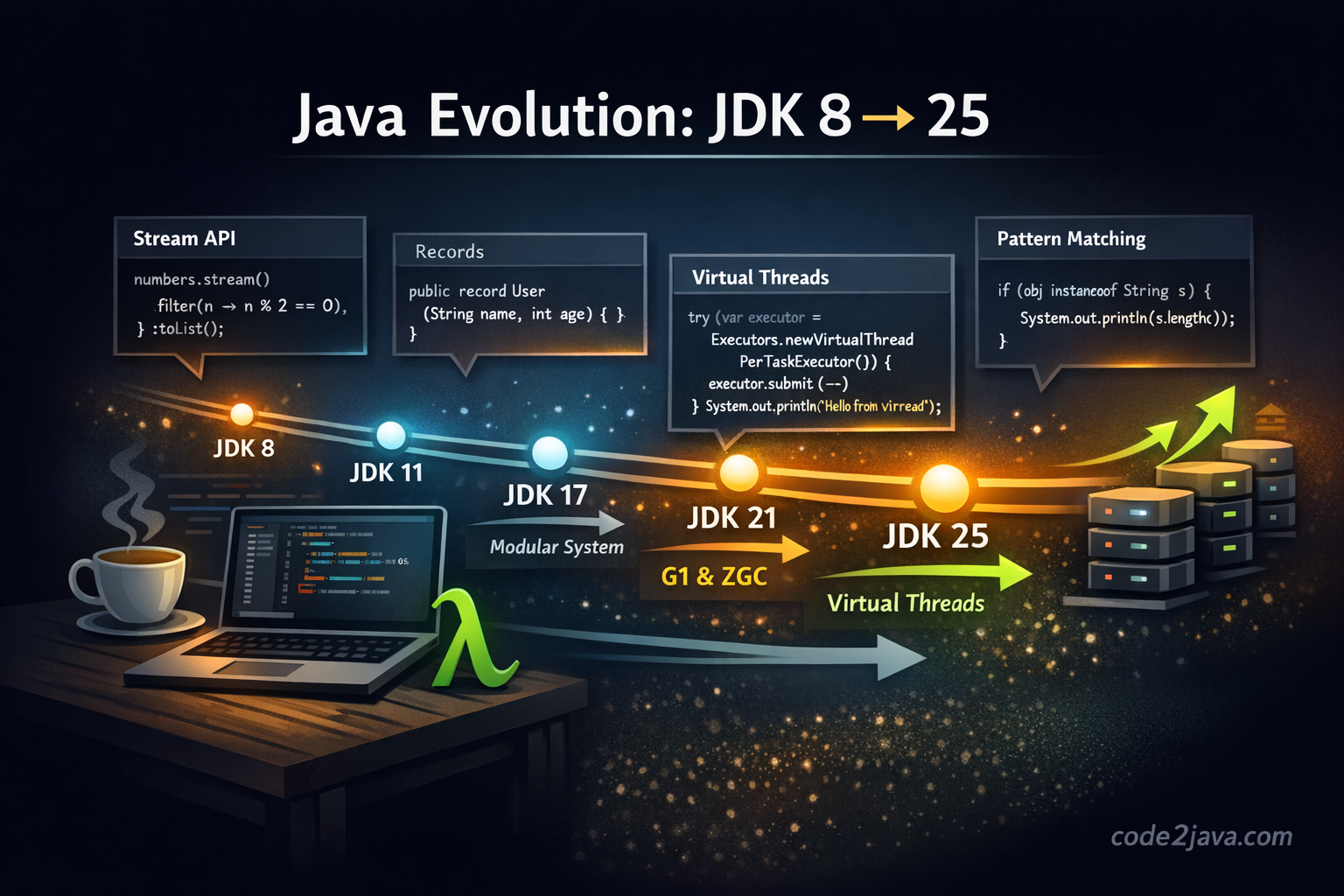
Evolution of Java from JDK 8 to JDK 25
Table of Contents
- Introduction
- What changed after Java 8?
- Evolution Timeline (JDK 8 → 25)
- Key Feature Deep Dive
- Streams → Reactive thinking
- Modular System (Jigsaw)
- Garbage Collectors evolution
- Switch Expressions & Pattern Matching
- Records & Sealed Classes
- Virtual Threads (Project Loom)
- Internal Changes & JVM Enhancements
- Security Improvements
- Performance Evolution
- Summary
- Interview Questions
Introduction
If you started Java around 2014–2016, chances are you lived in the world of Java 8 for a long time.
And honestly… Java 8 was revolutionary.
But what many developers don’t realize is 👉 the real transformation of Java happened after JDK 8.
Java didn’t just add features — it reinvented itself:
- Faster release cycles
- Modern language features
- Massive performance upgrades
- Completely new concurrency model (yes, Virtual Threads 🔥)
Let’s walk through this evolution like developers — not like documentation.
What changed after Java 8?
Before Java 8:
- Releases were slow (years apart)
- Big-bang updates
- Hard to adopt new versions
After Java 9:
👉 Java switched to a 6-month release cycle
That changed everything:
- Continuous improvements
- Faster innovation
- Smaller, incremental features
Evolution Timeline (JDK 8 → JDK 25)
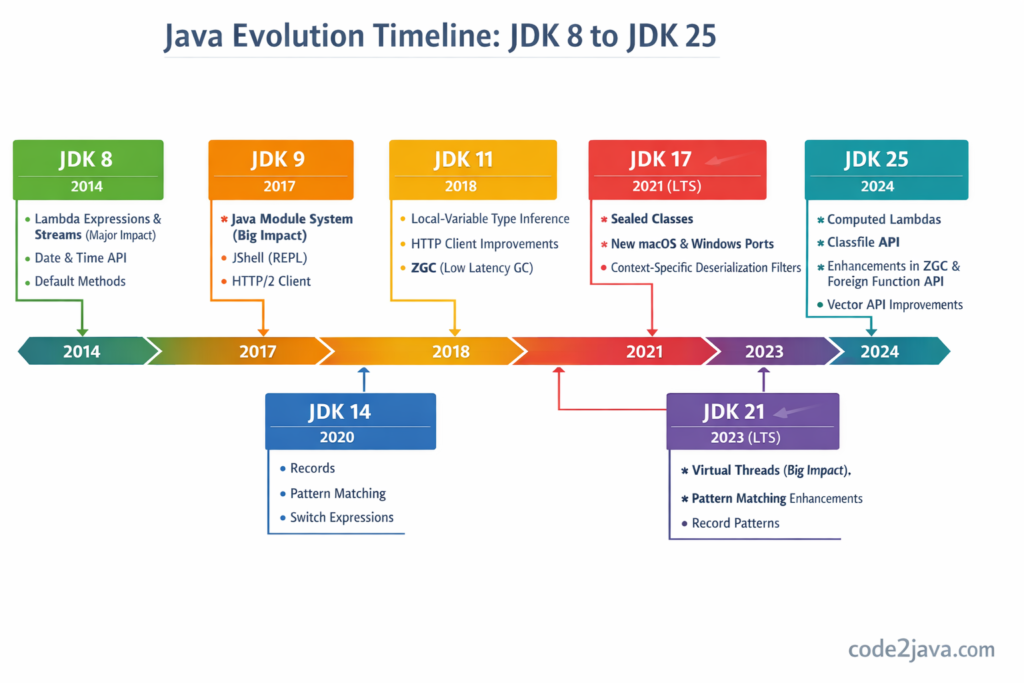
| Version | Key Highlights |
|---|---|
| JDK 8 | Streams, Lambda, Optional |
| JDK 9 | Modules (Project Jigsaw) |
| JDK 10 | var (local type inference) |
| JDK 11 | LTS, HTTP Client |
| JDK 12–14 | Switch Expressions |
| JDK 15 | Text Blocks |
| JDK 16 | Records |
| JDK 17 | LTS, Sealed Classes |
| JDK 19–21 | Virtual Threads (Loom) |
| JDK 21 | LTS, Structured Concurrency |
| JDK 22–25 | Performance, Panama, Valhalla progress |
Streams → Functional & Declarative Thinking
Java 8 introduced Streams, but their real impact unfolded later.
Before Streams
List<Integer> evenNumbers = new ArrayList<>();
for (int n : numbers) {
    if (n % 2 == 0) {
        evenNumbers.add(n);
    }
}With Streams
List<Integer> evenNumbers = numbers.stream()
    .filter(n -> n % 2 == 0)
.toList();👉 Internally Streams use:
- Lazy evaluation
- Pipeline processing
- Spliterator for parallelism
Evolution after JDK 8
- JDK 9 →
takeWhile,dropWhile - JDK 16 →
Stream.toList()(immutable list 🔥)
👉 Behavior Change:
- Earlier
collect(Collectors.toList())→ mutable - Now
toList()→ immutable
⚠️ This difference can break code if not understood.
Modular System (Project Jigsaw) – JDK 9
Before Java 9:
- Everything on classpath
- No strong encapsulation
After Java 9:
👉 Introduced modules
module com.example.app {
    requires java.sql;
}Internal Working
- Uses
module-info.java - Enforces strong encapsulation
- JVM checks module boundaries at runtime
👉 Benefit:
- Smaller runtime images (via jlink)
- Better security
- Faster startup
Garbage Collector Evolution
Java moved from throughput-focused GC → low-latency GC.
Timeline:
- JDK 8 → Parallel GC, CMS
- JDK 9 → G1 default
- JDK 11+ → ZGC (low latency)
- JDK 12+ → Shenandoah
ZGC Example
👉 Pause times < 10ms even for large heaps
Internal trick:
- Colored pointers
- Load barriers
- Concurrent relocation
👉 This changed Java’s use in:
- Real-time systems
- Trading platforms
- Large-scale microservices
Switch Expressions & Pattern Matching
Java moved toward expressive syntax.
Old Switch
switch(day) {
    case MONDAY:
        return 1;
}New Switch (JDK 14+)
int result = switch(day) {
    case MONDAY -> 1;
    default -> 0;
};Pattern Matching (JDK 17+)
if (obj instanceof String s) {
    System.out.println(s.length());
}👉 Internal Benefit:
- Reduced casting
- Bytecode optimized with fewer checks
Records & Sealed Classes
Records (JDK 16)
public record User(String name, int age) {}
👉 Generates:
- Constructor
- Getters
- equals/hashCode
Internal:
- Stored as final fields
- Immutable by design
Sealed Classes (JDK 17)
public sealed class Shape permits Circle, Square {}👉 Controls inheritance
Benefit:
- Better domain modeling
- Compiler-level restrictions
Virtual Threads (Project Loom) – Game Changer 🔥
Traditional Java:
- 1 thread = 1 OS thread
- Heavy, expensive
Virtual Threads:
👉 Lightweight threads managed by JVM
try (var executor = Executors.newVirtualThreadPerTaskExecutor()) {
    executor.submit(() -> {
        System.out.println("Hello from virtual thread");
    });
}Internal Working
- Uses continuations
- JVM schedules threads, not OS
- Parking/unparking without blocking OS thread
👉 Impact:
- Millions of threads possible
- Perfect for I/O-heavy apps
Internal JVM Enhancements
Over time JVM improved in:
- JIT optimizations
- Escape analysis
- Inline caching
- Tiered compilation
👉 Result:
- Faster startup
- Better memory usage
- Reduced CPU overhead
Security Improvements
- Strong encapsulation (JDK 9)
- TLS 1.3 support
- Removal of weak algorithms
- Security Manager deprecated
👉 Modern Java is more secure by default.
Performance Evolution
Key improvements:
- G1 → default GC
- ZGC → ultra-low latency
- CDS (Class Data Sharing)
- AOT (Ahead-of-Time compilation experiments)
👉 Real-world impact:
- Faster microservices startup
- Better container performance
- Reduced memory footprint
Summary
Java didn’t just evolve — it transformed.
👉 From JDK 8 → JDK 25:
- Language became expressive
- JVM became smarter
- Concurrency became scalable
- Performance became predictable
🔥 The biggest shift:
Java is now built for cloud-native, scalable systems.
Interview Questions
1. What major change happened after Java 8?
👉 Introduction of 6-month release cycle
2. Difference between Stream.toList() and Collectors.toList()?
👉 Immutable vs Mutable list
3. What is Project Loom?
👉 Lightweight threads managed by JVM
4. What problem does ZGC solve?
👉 Low latency GC pauses
5. What are Records?
👉 Immutable data carriers
6. What is the use of Sealed Classes?
👉 Restrict class hierarchy
7. How does module system improve Java?
👉 Strong encapsulation and smaller runtime